
HoofHearted
-
Posts
1,024 -
Joined
-
Last visited
Content Type
Gallery
Profiles
Forums
Events
Everything posted by HoofHearted
-
There’s a lot here to work through so bear with me on this wall of text. Call sheets are there as a tool - generally it’s there as a reminder that you like certain calls in certain situations coming into the game. What you actually call, once you get out of your scripteds, is going to be based on what the defense is actually giving you. That’s why the scripted plays are so important. Those plays are essentially being used to gain an understanding of how a defense wants to play specific sets, personnel groupings, concepts, etc. Once you’ve run through the script you now have a clear picture of what a defense is going to do the remainder of the game and can start making adjustments based on that information. As far as getting a play call in there are various systems which use their own languages in order to breakdown a play. Specifically for the Bills we fall under the Erhardt-Perkins system which is a concept based system. There’s a bunch of memorization involved in the call. Basically a call, or code as you refer to it as, is broken down into a couple pieces. Let use a pass concept for example - the first piece will be the name of the formation and any motion tied to that formation - second piece the protection - and third piece the concepts. I don’t know specifically what the Bills terminology is for things, but I’d bet it’s similar to what the Patriots have used in the past for a lot of things since the foundation of our offense is built around what Brian Daboll brought here. So as a real life example let’s say you are in 10p and want to run some type of flood concept you could call - Spread Rt Strong (formation) 72 (protection) Ghost Tosser (Strong side and weak side concepts). What’s really nice about this system is that the concepts are the concepts and you can teach them holistically. So the #1 receiver will always run a vertical in Ghost (doesn’t matter who it ends up being), the #2 will run a Sail, and the #3 an arrow. So in the example provided it’s a true 2x2 set with the #1 receiver to the strong side running a Vertical, #2 running a Sail, and #3 is the RB running an arrow out of the backfield. Backside you have double slants (Tosser). Lets say you want to take that same concept but now run it out of a 21p set. Well now you can go 0 Near Slot (Formation) Hat (motion) 72 (protection) Ghost Tosser. 0 Near Slot gets you into a 2x1 formation with twins to one side and a nub tight end to the backside with a near I set in the backfield. Hat motions your RB out wide to the nub tight end side of the formation and then you run the concept as called from there. So now the RB is running the vertical, the tight end is running the sail, and the FB is running the arrow. It’s really nice because you don’t have to have calls that are 1,000 words long like in other systems which breakdown the responsibility of each player within their calls. It is, however, a lot of memorization on the players part. Personnel packages are always tagged with names. Again, it’s another thing that just needs to be memorized. Substitutions follow your depth chart. More often than not your receivers specialize either outside or inside receiver since they can vary drastically in what is asked of them, but ultimately it becomes who’s the next best available that knows the position. There’s plans in place made throughout the week with how to handle substitutions but ultimately it falls on the position coaches to get the right guys out there given the situation. Personnel will always be determined prior to play call. No huddle is the same concept as getting a play in. Typically your no huddle or 2 minute offense playbook is limited in the number of things you can run, but they’re typically called by the QB with one word or phrase that defines the formation, protection, and concept. Post-snap each concept has its own read progression. This could be a receiver progression or reading a defender or multiple defenders based on what the concept is. For example, when we run mesh it follows a receiver read progression for the most part. On Deep Choice you’re reading a defender and throwing based off of what that defender does post-snap. Hope this helps, and if I need to clarify anything please let me know.
-
The system will remain the same as far as general concepts and terminology. I anticipate he'll put some of his own wrinkles into the gameplans. As far as if it will look the same - I can't really answer that until after the game Sunday. Play callers each have their own philosophies and nuances to how they go about things - for example, we're running the same defensive scheme we ran when Frazier was here - it looks different now that McDermott is calling it - but the framework is all the same. We'll know more after the Jets game.
-
I respect your response, but this thread isn't to meant to go back and forth about what is or isn't working. I've explained what is happening from a schematic standpoint in the scenarios you were referring to about "spacing issues". I hope you can respect that.
-
I understand where you're coming from with your thought process. I think a lot of what you're seeing is more a reflection on how the game has changed over the last 10 years more so than anything. In terms of scheme, the linebacker position is essentially an entirely different position now than it was 10 years ago. The way the position is taught is completely different. The physical attributes you look for at the position is completely different. So if your mindset of blue chip prospect is just a dude who is a thumper - that doesn't really exist as much in the game anymore. Run schemes are run schemes - there's wrinkles and small variations within them but in general what you see in high school will be the same way it looks in the NFL - just faster and more violent. Anything specific you'd like to see from any of those? I'm more than willing to get into talking scheme.
-
I apologize. I haven't done a great job of explaining how Deep Choice works on here. Only one of the receivers in the concept will have the option route. So for example lets say we're running "DC2" which is Deep Choice to the slot receiver. You're #1 receiver (widest receiver to that side of the field) is running what is called a "collector" route. Essentially it's his responsibility to occupy the corner outside - he does this by pushing vertically until he can get in that corners cushion and then will shut it down right in front of him to draw him into coverage (typically a comeback route). The #2 (slot receiver) is the one running the option route. - Lets say it's cover 1 and he sees a corner pressed outside of him on the #1 and a safety walked down on top of him - he will take an outside release and run a vertical pushing toward the sideline (Slot Fade) in order to work as far away from the MoF Safety as possible. - If it's a Cover 3 look he'll run a straight vertical off the LoS and try to split the corner and MoF Safety up the seam - if the corner carries and squeezes the slot vertical then the QB will check it down to the #1 receiver who ran the 10 yard comeback. - If it's a Cover 2 look the slot will push vertical and run a Post to the open middle of the field. - If it's a Quarters look you can either run a Corner to the sideline away from the Safety or a Dig right underneath (this is gameplan specific for the opponent). Essentially it sets up your option guy to run to green grass and have the best possible opportunity to be open on the play. So while I understand your thought process - it doesn't actually play out that way. EDIT: And just to be clear this is just one example of the many variations of choice concepts we run.
-
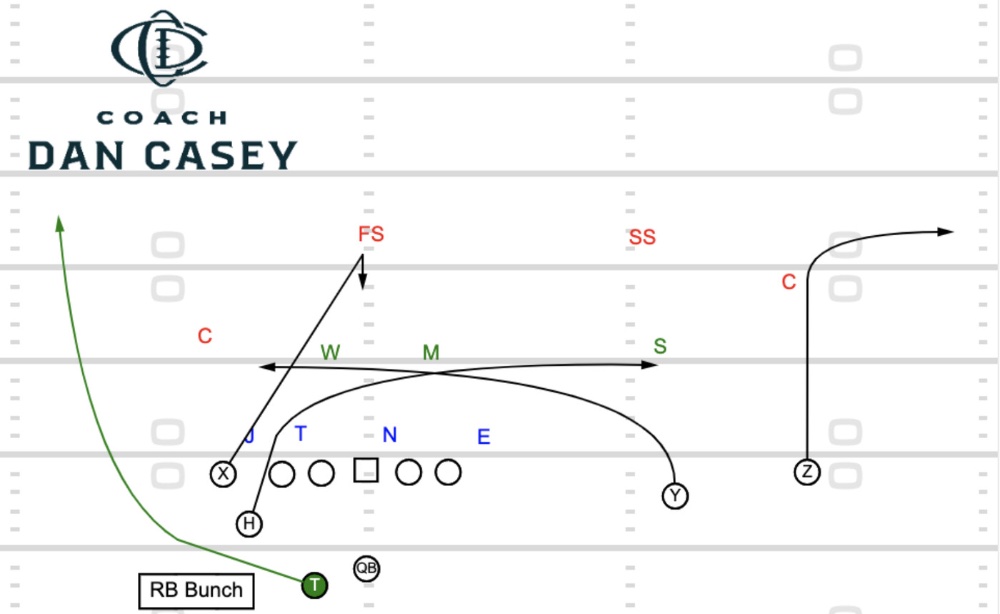
Right. That's all intentional. The play is designed to attack the underneath coverage of the defense and put a ton of stress on them to try and fit that out. Generally speaking we mostly see 4-2 or 3-2 boxes which essentially means we're seeing two backers (often lined up in 30's) responsible for the hook to curl zones. This concept puts those defenders in conflict if they are running zone coverages. There's two ways the concept can be played - either the two backers pass off the crossers to the other backer and they widen with the route until they can pass it off to the curl/flat defender which then opens the passing lane for the snag route sitting over the center at 10 yards - or they match the routes and run with them in which case whoever is covering the underneath crosser will get picked by the receiver running the deeper crosser. If it is man coverage the backers either won't be there because they are both blitzing or one backer will be there playing a Rat concept (essentially a low hole robber) - if they Rat then the backer will end up sitting under the snag and the DBs in man responsibility will play the concept just as I described above with the backers matching the routes (the deeper DB will get picked). Typically the progressing to this concept looks at the RB on the wheel first if the QB reads man coverage pre-snap then works across the field to the crossers then snag. The backside Out is your man match-up if you like it.
-
Bernard has certainly been coming along. He's still learning and improving, but he's been trending upwards the entire season which is really good to see. He plays extremely fast and has the same type of play style as Milano which is really good to see. Athletically he's got it - he lacks size but is able to overcome a lot of situations because of his athleticism. More often than not he's able to use his athleticism to bend around blockers working up to the second level, but when he does get engaged he naturally gets pushed because of his lack of size. What I love is that in those situations he stays active - actively working feet - actively working escapes - always trying to get off the block and more often than not does. In Coverage he's at his best in pattern match schemes where he's able to drop to a specific player and everything turns into man eventually. Where I think he can get caught at times right now (and its certainly not just him) is awareness when he's working a true zone drop - understanding where his fit in the coverage is and how to relate to routes in those fits. A lot of eyes in backfield pulling him off simple underneath coverages. Dodson has been improved with more reps as well. Obviously he's a liability in the pass game due to lack of athleticism, but he has been much more consistent recently in run fits and pulling the trigger, but there are still lapses there. He plays slower than Bernard, but I've seen that improve as well as the season has progressed. He's a decent back-up, but he can't be relied upon to be an every down backer.
-
Every time Cover 1 talked about spacing issues it was Mesh that he was talking about. EDIT: I have seen people on here complain about spacing issues on scramble drill.
-
This whole spacing thing didn’t show up until this year when we started running a mesh concept quite a bit. Mesh creates a rub across the field and uses a snag that sits over top of it. This gives you both a man beater concept and zone beater concept all within the same full field concept.
-
That was on a rub route.
-
Deep Choice will likely still be a big part of this offense. He ran a bunch of it while at LSU. What may happen is he limits the volume of choice plays they have and instead focus on just a few. Really the only times we saw that was on Mesh concepts (which that’s part of the design of the play) or on scramble drills.
-
We HAVE to win the LoS. Specifically, early on we’ll need to be able to run the ball off tackle. Against the Jets I’d expect some type of Buck or Pin & Pull schemes to accomplish this. I don’t think we’d have a chance to be successful just trying to run outside zone. We also need to be able to attack the perimeter in the pass game early on using flat screens and RPOs. Anything to get the interior of their DL moving sideline to sideline and wear them down. If we can successfully do that it opens up our play action game off of that action which should allow Kincaid to get going. Jets play like us defensively - they’re not going to give up the deep ball and they’re good at playing tight underneath. Change of strength motions and shifts would be big to get them having to communicate and make checks right before the snap but with a short week I’m not sure how much of that to expect because I have no clue how much of that is currently built in to the system. We need to make a conscious effort to motion Diggs away from Sauce as much as we can to get him going. Still think Deep Choice will be a big part of what we do. The easy answer is different systems specialize in different things, but on top of that how a defense is playing you will dictate what concepts you want to use to attack teams. Pros and cons depend on how the defense is playing you.
-
The biggest and most important thing (and probably the tallest task) is to rebuild the confidence in that offensive room. He has to command the room from the jump, show a clear direction for where he wants to take things, and be able to provide answers when questions ultimately arise. If he can’t do that then it doesn’t matter what we do as far as scheme is concerned. Can you provide more detail? Are you speaking of teams struggling to find competent players or just that they are harder to project to the next level now?
-
Just wanted to throw this out there as an outlet for some of you guys to get answers on scheme, specific plays, coaching, etc. What I envision this thread being is a place where you guys can come ask questions and I can help provide answers all in one place instead of a lot of answers being buried 12 pages deep in sporadic threads every week. I’ll try my best to get to everyone’s questions as quickly as I can. What I do not want this thread to devolve into is a gossip/fire whoever/hot take of the week type of deal. I want this to be specifically about learning more about the game so if you’ve got something else, respectfully, take it to another thread. Thanks! Fire away!
- 117 replies
-
- 20
-

-

-

-

-
Well damn, how are sacks even a thing then!?!?!? 😉
-
I know this is going to come as a shocker to you so you might want to sit down, but pressure's don't get home because of the "element of surprise".
-
Yep. That’s definitely the downside to playing man. From a purely schematic standpoint it was a good call. We got the matchups we wanted (Poyer and Demar 2v1 on a back). If Poyer hits it tighter Demar has a shot at the sack. Playing Man 7 took away the quick throw and forced them into a pass that hits about 35% of the time versus a ten yard completion that’s around 65%. Definitely a gamble. Definitely not as egregious as some are making it out to be.
-
100% - we had poor rush integrity all night. We did a poor job with our low box/hi box rules. Ed was winning all night though.
-
I didn’t read the article. I’m sure the analytics stuff is fine. He’s just a hack. Sold himself as this big time NFL Consultant and it’s all false. He doesn’t know a dang thing about football. Just numbers. I need to just stop responding 🤣
-
Sure. That dudes a clown. End of discussion.
-
We did generate pressure. Ed was a monster all night. That’s why we didn’t blitz a whole lot. Did you watch the game?
-
-
He always has. This isn't anything new to this season.
-
is there a HC out there worth going after?
HoofHearted replied to dbfla10's topic in The Stadium Wall
In-game decisions as in play calling or as in situationals? -
My posts are always about football insight. Not sure what you're getting at in the rest of your incoherent post.